Monday, May 5, 2014

Blog 12- The Clash of Opinions

In class last week, one of the topics that we talked about was (Post) Modern Sociology. We talked about Huntington, Said, Inglehard and Norris. All of these sociologists have an opinion of how conflict will arise in the future.

Samuel Huntington said that there will be a conflict with the Western world and the Arabic (the Middle East and Northern Africa) World. He said that there would be a clash, because of the two main religions; Islam and Christianity. They are both "missionary" religions, meaning they share their faith. There will be a clash when they are both sharing in the same areas. He also says that they are both universal religions, meaning anyone can convert and no one is singled out. Both Islam and Christianity also do not accept no religious people.

However, Said disagrees and says that is a really racist and practically tries to disprove everything that Huntington is saying. Ingelhard and Norris say that Huntington may be right. However, it will be more of a clash of gender and sex rights; not over democracy. They say this because if someone looks at stats the Western and Arab world are comparable in terms of opinions of democracy. On the other hand, there are huge differing opinions on gender equality and homosexuality.

I could talk all day about how I agree or disagree with all of these sociologists. However, I would like to bring up my own opinion. I honesty think there will be a lot more fighting and wars in the days to come, but  I do not think that these disputes will be as worldwide as Huntington says and I also do not think it will be on religion. First off, let's look at Europe for example, Germany specifically. Germany is considered a rather secular nation. When I was there, I met only one couple that attend church regularly. I honestly do not thing Germany would go to war, because of Islam. They may fight against the Turkish immigrants though, because there has been a lot of them coming into the country in the last decade and a lot of people are not too happy about that.
I think there will be a lot more little wars that happen in our world like the Croatian War of Independence in the early 1990's and the conflict happening in Ukraine right now. Some of them may have a potential to turn into bigger wars, but I do not think it will pan out like Huntington thinks.


Pictured below is some pictures from the Croatian War of Independence. One is of a building someone set on fire and one is some pictures of the victims.


File:Muzej DR-crop.JPG File:Lovas1.jpg
Source: http://en.wikipedia.org/wiki/File:Muzej_DR-crop.JPG and http://en.wikipedia.org/wiki/File:Lovas1.jpg

Monday, April 28, 2014

Blog 11- Peter Burger

My favorite sociologist that we talked about last week was Peter Burger.
The biggest topic we covered was the Social Construction of Reality. He says that "society is a human product." Which means every way that we interact was all made up by society. The way we say hello, the way we eat, the way we dress was all made up by us.

He says that there is a process of how things become par of society.
First there is externalization. That is where someone thinks of an idea on how they interact with someone and then they act upon it.
Next is habitualization. It becomes a habit for this person; they do not even think about doing it and why they do it. It then also spreads to people around this person and it becomes a habit for them too and they also will not even think about the action before they do it.
Then the last step is institutionalization. This means that people almost enforce this new social norm. They may give them a weird stare or scold them for being deviant to the normal behaviors.

An example of this could be how people dress and what peopl consider to be modest clothing. For instance before the 1920's women wore longer dresses. One woman or a group of women may have thought that women should be allowed to wear shorter dresses, so she began to wear them. Because the way of dressing was not normal, they may have gotten scolded or yelled at for dressing like that. Other women might have seen them wear that and wanted to wear this too. Soon a majority of women were wearing dresses like this and they did not even think twice about dressing differently.
Below is two different pictures. The one on the left is a dress and hat advertisement from 1910. The one on the right is from 1925 or 1926. I actually did more research and found out that dresses again got longer after 1929. (If anyone was interested.) I think that is how most fashion trends come about.
Women_in_1920.jpg. Womens Hats Dresses, USA (1910) 

Monday, April 21, 2014

Blog 10- Talcott Parsons


Last week in class, we talked about Talcott Parsons. The main thing that we talked about was how he categorized interactions. One of the set of categorizes that he made was pattern variables. Pattern variables mean the expectations and structures that happen throughout a span of different relationships.

Here are a few examples of the 5 pattern variables he mentions.

-Affectivity – affective neutrality is the amount of emotion that happens in an interaction. For instance, I experience more emotion in my roommates’ relationship than I would with the cashier at Walmart. I give my roommates hugs and spend a lot of time with them. The interaction with the cashier would be pretty close to no emotion at all, any more emotion shared than that it would get uncomfortable.

-Achievement-ascription is the process of how we obtain different statuses. Achievement is where we have earned the status and ascribed status is where society gives us our status. For an example, my achieved status is student with a great GPA and my ascribed status is 21 year-old white female.

I think the pattern variables are really interesting, but I think that it almost puts interactions in a box and there is no deviance from those 5 ways to interact.


I took this picture of the internet and I think this is a good example of ascribed status. This is a picture from a German newspaper from 1929, Der Stürmer. People of that time would just label people as a Jew without even trying to include any other attribute of theirs. They would then use that label to add to what their status was. They would use words like “crook” and say they stole money from the rest of Germany. This example shows the power of what an ascribed status can do to a group of people.

Monday, April 14, 2014

Blog 9- The World is a Stage

Last week, we talked about self and identity. One of the sociologists that come up was Erving Goffman. Some of the topics he goes over is presentation of self, status and roles, self labeling and dramaturgy. 

Probably the most intriguing topic for me in class was dramaturgy. This term was really relateable, because I was in one musical and I was back stage crew for a lot of productions in high school. 

Dramaturgy is using the analogy of stages. We all have different stages that we are apart of. For example, I have a stage as a student and as a roommate. I act differently in both areas. At home, I would not be raising my hand to talk to my fellow roommates nor would I be sitting in class wearing sweatpants watching Doctor Who on Netflix. Note that I said that I would never wear sweatpants to class. Sweatpants would be considered "props" in terms of Goffman's dramaturgy theory. They would be considered a prop, because those sweatpants would be seen by others and they would base their ideas of me off of what I wear. It perhaps it may give off a signal that I like being comfortable, I do not care how I look or I am lazy. I do not wear sweatpants, because I use my clothes as a prop to portray to people who I am and I think sweatpants would give off a vibe to people that I am lazy first. (Sorry to all of you sweatpants fans out there.) This just shows the power of the audience. People are watching you; they have expectations for you and they will interpret your acting whether you like it or not. If the audience or society had no power, no one would care what other people wear and I would probably be sporting my sweatpants everywhere. 


"Rehersal on Stage" by Edgar Degas

Monday, April 7, 2014

Blog 8 - Me and I

 
In class today, we talked about George Herbert Mead.
His most famous theory was the theory of self. Self is someone's identity. There are actually two parts to the self and he calls them "I" and "me." The "me" is how you view yourself. "Me" is your own personality, your hobbies, your interests, etc.; it is all how you view yourself. The "I" is how others perceive you. This is how people view your personality, your hobbies, your interests, etc.
One may think that these two things are the same. However, that can be completely far from the truth. Perhaps someone does not like that they are quick to anger. They may try to hide it from the rest of society because they do not want people to look down on that person. So in simple terms the “me” is quick to anger, but the “I” does not have an anger issue at all or has the occasional, but not bothersome, spurts of anger.
 We also talked about Facebook in class and how people can present their “I” much differently than their “me” actually is. Some people may present themselves in a caring and selfless person on Facebook, but they may be self-centered in real life; their “me.”
I said in class that I sometimes use Facebook to see if people view my “I” as I see my “me.” I like to think that I am funny, so I post funny things on Facebook and people have the opportunity to like and validate my perception of myself. I normally do not get upset if people do not think of me is funny, but it is nice to hear when people let me know that I am funny.
I chose this photo, because I think it matches Mead’s ideas. The left side of the photo perhaps signifies how you perceive yourself, the “me”, and the right side of the photo could be how society views you, the “I.”    
"Split Personality" by Alexey Teterin

Monday, March 31, 2014

Blog 7- A Look at Diversity

Last week in my sociology class, we talked about Anna Julia Cooper. She had marvelous ideas, but because of the time frame that she was born in and the fact that she was African- American and a woman, her ideas were ignored for some time.

Some of the things that she talked about were race, sex and power. Probably one of the most intriguing topics we talked about was the section on diversity. In dealing with diversity, there are four ways that you can do it. One way is assimilation; "outside" cultures are supposed to conform to the main stream culture. Then there is segregation, where there is complete separation of differences. Third is genocide, which is the worst way to deal with differences. One example of genocide in American history is the "Trail of Tears." Many people died and this migration was all against their will.

The fourth way of dealing with diversity really got my mind going; Pluralism. I actually took a class on pluralism in Education before I decided to not pursue a career in education. This whole class taught me how to be accepting of others and their differences. We also learned more about different cultures to be able to understand our future students.

However, I am not too sure if I actually agree with pluralism. It sounds great, but once you start digging in to it, you realize that there may be some bad things that come out of it. Pluralism is where you celebrate the differences in culture while keeping your own. I think that it will actually turn into segregation. If people stay in their bubble of culture and celebrate their own culture, they will never venture out and learn about other cultures.


I choose this picture, because of the trend that I am seeing in education. They either are trying to enact pluralism or they are trying to make every one equal and having them assimilate. Even I felt like I was wearing the way too small one-size-fits-all t-shirt when I went to a public school for the first time in high school. It was an uncomfortable expirience, because I felt like I did not quite fit into the mold that they were trying to put us in. However, I really did not want to fit in the mold that they put me in, because I wanted to be true to myself and not let anyone tell me who I should be.

In conclusion, it was reather interesting to learn about Anna Julia Cooper. I loved hearing about her findings. Her thoughts definately had sparked a lot of thoughts.

Monday, March 24, 2014

Blog 6- The Persuit of Happiness

A few weeks ago in my sociology class, we discussed the sociologist Harriet Martneau.
I really enjoyed learning about her views and it was nice learning about a woman sociologist. I feel as though early women sociologists do not get the credit they deserve. Ms. Martneau was not even in our textbook. Some people do not consider early women sociologists to be actual sociologist, because they were not trained in the field. However, Marx was not trained either.

One of Harriet Martneau's ideas was the "Law of 'Social Life.'" This means that people are always looking for happiness in something. We try doing things that make us happy. For example, some people buy nice clothes or go on vacations, because we think it will makes us feel good. Sometimes this pursuit of happiness can be for the happiness of others. We may do things that make us unhappy, but we still do them because it will make someone else happy. For example, I absolutely hate doing my dishes, but I do them because it makes my roommates happy.

I think that Harriet Martneau has a good idea, but I do not think it is entirely correct. She is right for the most part. I think most of our motives for things is in the end happiness. People get a college education, because it will help them get a job which will bring them money which they believe will eventually bring them happiness. I listen to my mother all the time when it comes to wedding planning, because I think she will be happy with me if I do what she says.

However, I think that this pursuit of happiness will not satisfy a person. People work so hard to try to be happy, but they sometimes end up empty handed. People work really hard to get a college education and they hope it will bring them a nice job that will pay them a lot, but sometimes it does not turn out the way they want. College grads sometimes get a low paying and unsatisfying jobs and then they end up feeling like a failure. I also listen to my mother way to much, when it comes to wedding planning, and I am super unhappy, because the wedding has nothing that I wanted.


http://franthony.com/wp-content/uploads/2012/11/happiness.jpg

Sunday, March 2, 2014

Blod 4- Max Weber and Authority

This past week, my Sociology class discussed Max Weber. Two of the things we talked about were Bureaucracy and Authority. The subject that intrigued me the most was the three forms of Authority. The first form is rational; the police are put into power for a reason and we should follow them. The next is traditonal. We do things because "it is tradition"; there is no other logic to why we follow that authority. The third is charasmatic authority. That is where we follow a certian authroity because it is appealing to us.

The form of authority that I realted to the most was traditional authority. I am getting married this coming August and I am expirienceing this form of authority firsthand. All the time that I am planning my wedding, I am hearing my mother saying, "You have to do this; it is tradition." "No one does that, Andrea, that is too non-traditional." It is really frustrating sometimes, because I want to have my wedding the way my fiance and I want it and yes, somethings are not traditional. You should have heard the hour conversation on why I could not wear glitter TOMS for my wedding shoes with my mother.

I have no choice but to follow these traditions, because people will see my do something outside of the social norms and they will think less of me. I do not want people to look down on me, so I still go along with a more traditional wedding.


I chose this photo, because correlates with what I am going through right now and it has to do with traditional authority. I looked at a wide variety of pictures of weddings from a long time ago. These pictures that I looked at all reminded me of tradition. However, the way weddings look today is because people defied traditional authority and did what they desired.

Monday, February 17, 2014

Blog 2- Marx and Religion/Ideology

In my sociology class for the past week, we talked about Marx and his views. I will admit, I got a bit angry in class when hearning about what he thinks.

He said that religion and other ideologies were a "human construct" and "opium for the masses." He refers to religion to be like opium because people used it as a medicine/ pain killer during his time. Opium also puts you in a haze to reality. One cannot think clearly and see reality, when they believe in a higher being and see the world through their beliefs.  Marx believes that that is unhealthy for society.

I really think that is conpletely not true. I, personally, belong to a religion and I think Marx has it wrong. For me, being in a religion give me clarity and a sense of purpose. It gives my clarity, because I can sit at the end of the day and read through some readings and pray. It helps me clear my mind from all the hustle and bustle and hecticness of my day. If I did not have that time, I would be so stressed out from the world; my head would spin. I think all that stress would put me in a haze and fog my sense of reality more than anything.

It also makes me think, if religion and other idiologies are not ok to have. Then what should we believe in? Are we supposed to just go through life as a robot having people tell us what to do, because we are not allowed to believe in anything and live for anything. That honestly does not sound like fun at all. That would be just wasting our precious human lives. I am not just saying that religion is the only thing people should believe in. Believing in being a good person, being kind of others or giving to charity are great things. That all benefits society and I really do not see how those ideologies could be bad for society.


10. Maps are majorly trendy right now! Map something from your life: your house, your room, your neighborhood, a class... It's your call. 2 pt.

This is a map of Moscow made by Anna Simmons, a british artist who specializes in making maps into art. I chose a picture of a map, because I see having a religion or an ideology is like a map. If we want to go somewhere, a map can show us where that point is and how to get there. In my religion, if I want to change something in my life, I just look to my readings and it tells me how I should get there. I feel like if I did not have a map on how I should live my life, I feel like I would just be wandering through life constently lost, having no purpose and not going anywhere meaningful. I would feel usless and being wasteful of the life I have been given. 

Monday, February 10, 2014

Blog 1- Individualism


Alexsis de Tocqueville is known for coming up with the term individualism. Individualism happens when a person takes themselves away from society and they look to themselves for how they are going to act in a situation. This term is to not be confused with egoism. Egoism is almost the same thing, but it is more an internal obsession with oneself. Individualism is where a person takes action based on what they think alone.

Thinking back on class discussion, I realized that America is a very individualistic society. I have people all the time telling me that I should go to school and major in what I want to major in. I am told get the job that I want and pursue my own individual dreams. But is this idea a good thing? Can only focusing on yourself be a problem?

I honestly think that individualism could be a problem. We care more about ourselves than the common good. I personally think that individualism has led to greed in our economy and producing greedy businessmen that do not care about the employees at the bottom of their business food chain. They could care less if one of their employees cannot put food on the table; they just care about their new Mercedes.  Individualism could also be a good thing too. If one only cares what other people think, they will never take cares of themselves. I personally have made some great decisions based on my individual wellbeing and I do not regret those choices. However, I have also made some selfish decisions and I regret them completely.

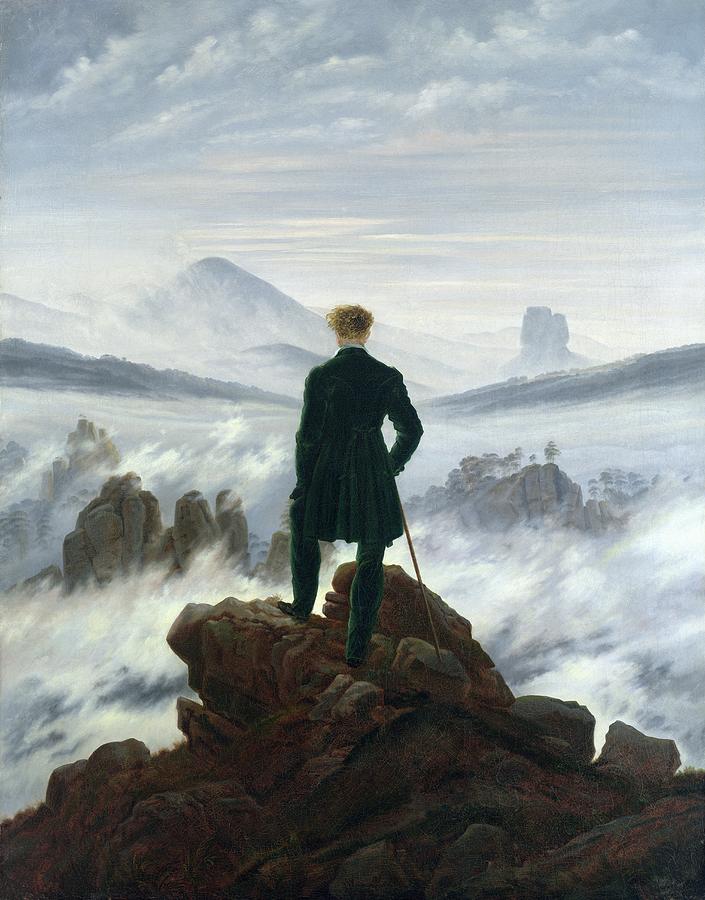
This picture is by a famous German artist. I chose this picture because I think it describes individualism quite well. The “Wanderer” has separated himself from society, just like a person being individualistic would do when acting out their own decision.

"The Wanderer above the Sea Fog" by Caspar David Friedrich